What is the game about?
Basically, Terminal Status revolves around a group of 20-somethings attending a space academy and the complicated web of relationships (romantic and otherwise) that they're all caught up in.
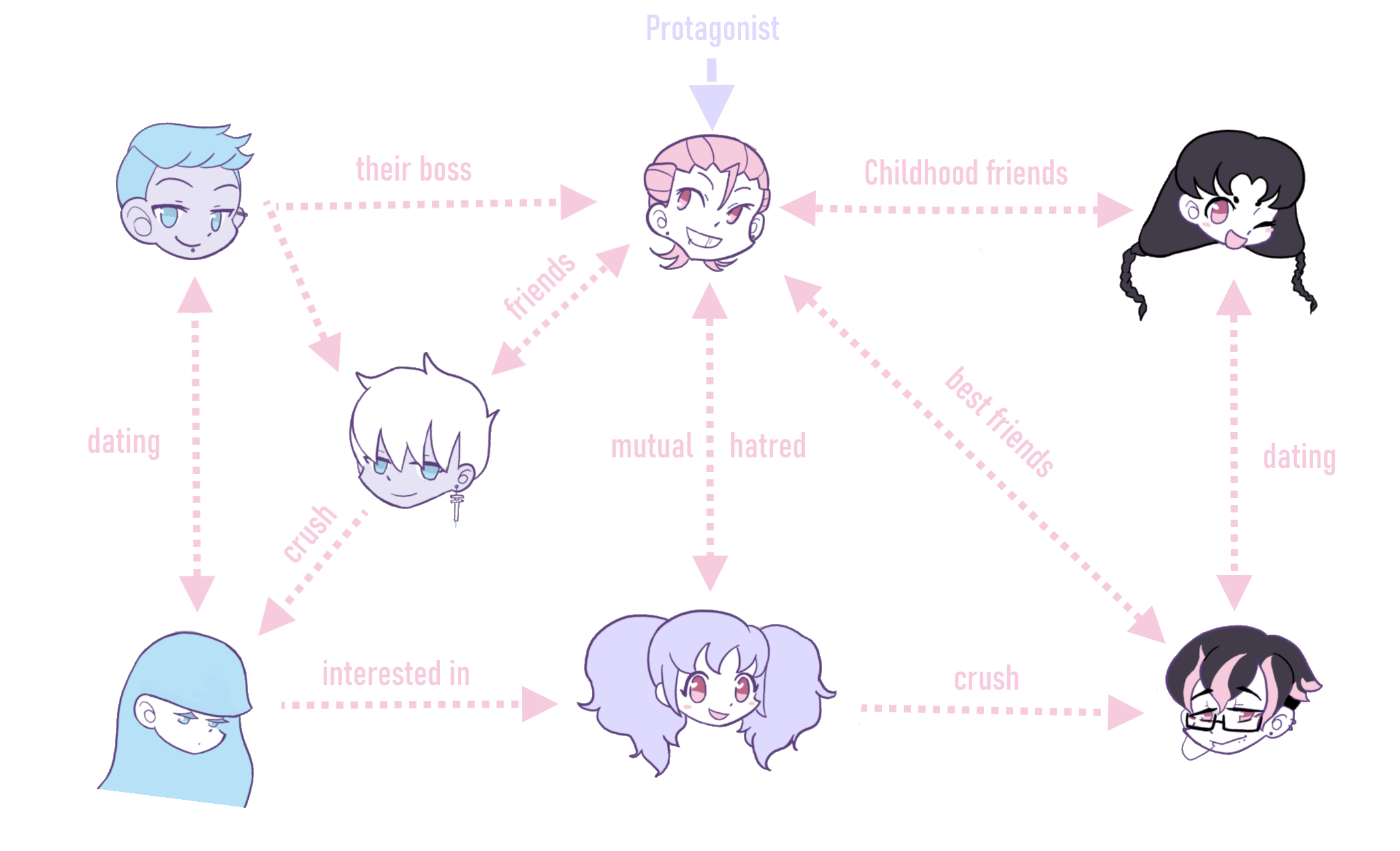
A lot of the fun comes with exploring how everyone connects to one another, as well as speculating on the feelings of the one caught in the middle of it all (our protagonist is not exactly a reliable narrator).
What else is it about?
Disability
Disability, whether it be through metaphor, imagery, or explicit representation, influences every part of this game.
Throughout the story (and starting far before it), an interstellar war is waging on in the background of Terminal Status. What's the cause of this war? It doesn't matter. The war is just a metaphor for the violence that is always occurring, for the struggle some of us fight through every day, and for the fact that whether you're weak or strong all of us are equally likely to get our worlds rocked by a freak accident (or a big mech with a sword. Big mechs with swords are truly the great equalizer).
Said mechs are called TR4-UMAs (or UMAs for short). Many members of the cast are UMA pilots; the way they interact with their UMAs serve as a metaphor for how they treat their bodies. Your body can be something you live in, your home that you learn to properly love and maintain; and your body can also be a tool, something that merely gets you from point A to Point B.
We survive in them, when times are tough. And sometimes we're reckless with them, when everything feels out of control and we have no other outlet.
The idea of health (mental and physical) is embedded into every facet of the story, especially the naming conventions. Everyone and everything in Terminal Status (including the TR4-UMAs) have meaningful names... and by 'meaningful' I actually mean edgy, because as thoughtful as thoughtful as I'm trying to make this story I also wanted to be self-indulgent and throw in a bunch of words that I thought sounded cool.
Menhera
Another one of Terminal Status's major influences is menhera. While normally associated with fashion and artwork, I like to believe the aesthetics and history of menhera also contain certain themes that can be applied to writing.
Menhera is a Japanese subculture born out of a need to push against the stigmatization and suppression of mental health topics. Struggling people are considered "too loud," their lived experiences "too heavy," their scarred bodies flagged as "mature" or "horror." When society treats suffering as something ugly and taboo, menhera's response is to rebrand it into something fashionable and trendy--something cool, something cute, something loud and dressed up and shown off instead of hidden.
Why is it wrong to be attention-seeking, if you're hurting and need attention? Why is dressing and acting like a 'cry for help' something that makes people turn away instead of answer that cry? Why is suppressing what's wrong with you seen as performing acceptibility, and where does that acceptance actually lead you?
Menhera is cute pastels and dark imagery, but it's also about expressions of pain--about being allowed to express pain. In practice, this looks like people who are hurting and are craving release, rest, and for things to stop hurting (whether they find that through healthy methods or not).
And there's a reason why medical aesthetics appear so often in menhera works. So often when facing severe mental illness or disability, the hospital is a place you go when you reach your breaking point and need to be taken care of. Where pain becomes gentleness. Where suffering becomes sweetness.
Terminal Status is a story that interrogates what strength is, what resilience looks like. It explores the longing for comfort and sanctuary, and the lengths some people will take to find it. This is a story about people who want to get better, people who want to get worse, and people who just wish things were easy.
Ripping off a Shoujo Manga
So basically there was this one shoujo manga that I loved, up until it made me really mad... So I thought, "why not rewrite this story, but change the parts I don't like? And what if I replaced the characters with queer adults? What if I took all the parts about Japanese high school life and changed it to intergalactic mech battles in space? And what if it was all actually completely different?"
And that's what Terminal Status is about.